Meta Ads vs Google Ads for E-commerce Where Should You Spend First
July 23, 2026
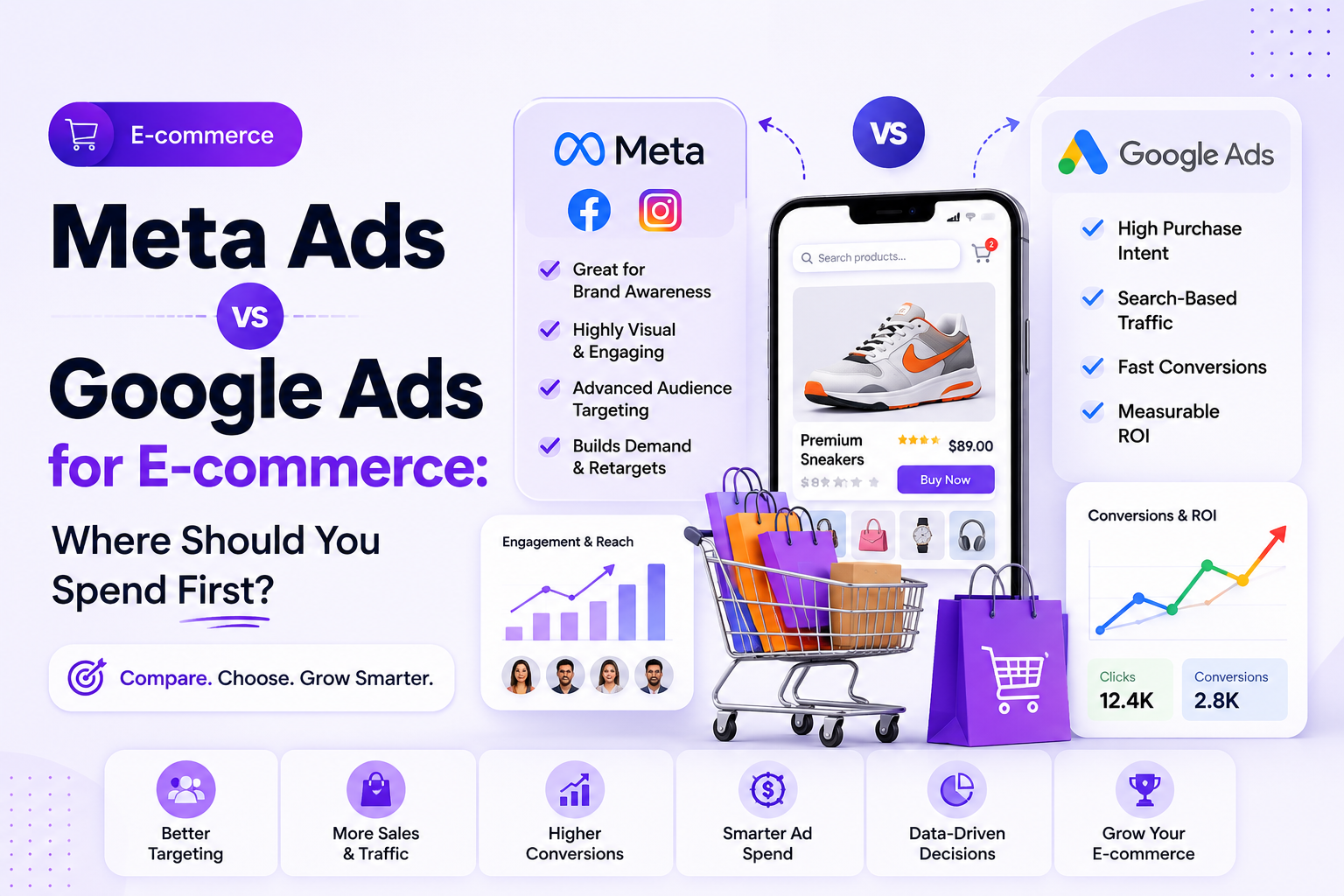
Every e-commerce brand eventually hits the same fork in the road: limited ad budget, two platforms, and pressure to prove ROI fast. Meta Ads and Google Ads solve different problems, and spending on the wrong one first can quietly burn weeks of budget before the data even makes sense.
This isn’t really a “which platform is better” question. It’s a “which platform matches where your brand is right now” question — and the answer changes depending on whether you’re launching a new product, scaling an existing bestseller, or trying to recover from a plateau.
Did You Know? Google Ads primarily targets active search intent — people already looking for a product — while Meta Ads reaches people based on interests and behavior, often before they’ve started searching at all.
Google Ads is fundamentally intent-based. Someone types “buy running shoes online Australia,” and your ad appears because you’ve bid on that exact search. The customer is already in buying mode.
Meta Ads (Facebook and Instagram) works on interruption and interest. You’re not waiting for someone to search — you’re showing up in their feed based on demographics, interests, past behavior, and lookalike audiences built from your existing customers. It’s discovery-driven, not search-driven.
Neither approach is inherently better. They sit at different points in the customer journey, which is exactly why the “where should you spend first” question has a real, practical answer rather than a generic one.
Meta Ads tends to perform best for e-commerce brands in a few specific situations:
Pro Tip: Dynamic Product Ads on Meta, built from your product catalog, consistently outperform static creative for retargeting because they show the exact item the shopper viewed.
Google Ads tends to win when:
Cost structures differ meaningfully between the two platforms, and this is often where the “where to spend first” decision actually gets made.
| Factor | Meta Ads | Google Ads |
|---|---|---|
| Pricing model | Primarily CPM (cost per 1000 impressions) | Primarily CPC (cost per click) |
| Typical strength | Lower cost per reach, higher volume | Higher cost per click, higher intent |
| Best for | Top and middle of funnel | Bottom of funnel, ready-to-buy |
| ROAS pattern | Can be volatile, improves with retargeting data | Often more predictable once keywords are proven |
In practice, many Australian e-commerce brands find Meta Ads cheaper for building initial awareness and audience data, while Google Ads delivers more predictable ROAS once there’s enough search volume around the product to justify the spend.
Expert Insight: In our experience running paid campaigns for e-commerce clients across different growth stages, the brands that struggle most are the ones that pick one platform permanently instead of shifting spend as their store matures. A store six months old and a store three years old should not be running the same channel mix.
For most e-commerce brands past the very early stage, the real answer isn’t “Meta or Google” — it’s “Meta and Google, in the right proportions.” Meta builds the top of the funnel and feeds Google Search with people who now recognize your brand name. Google then captures that demand at the point of purchase, along with organic and branded search traffic Meta helped generate indirectly.
A common allocation for growing brands is weighting spend toward Meta early for discovery, then shifting a larger share toward Google Shopping and Search as branded search volume and repeat purchase data build up.