
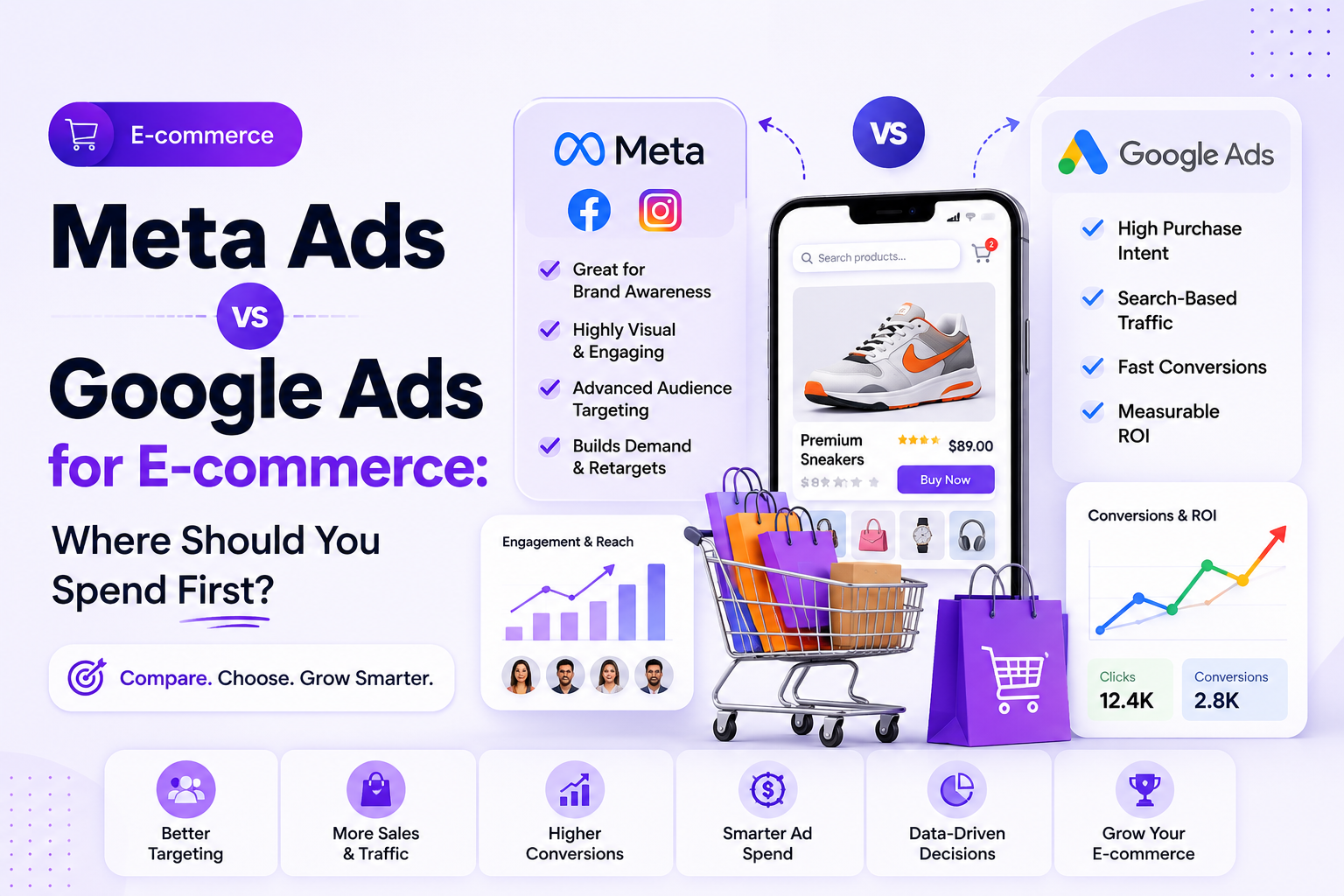
Every e-commerce brand eventually hits the same fork in the road: limited ad budget, two platforms, and pressure to prove ROI fast. Meta Ads and Google Ads solve different problems, and spending on the wrong one first can quietly burn weeks of budget before the data even makes sense.
This isn’t really a “which platform is better” question. It’s a “which platform matches where your brand is right now” question — and the answer changes depending on whether you’re launching a new product, scaling an existing bestseller, or trying to recover from a plateau.
Did You Know? Google Ads primarily targets active search intent — people already looking for a product — while Meta Ads reaches people based on interests and behavior, often before they’ve started searching at all.
How Meta Ads and Google Ads Actually Work {#how-they-work}
Google Ads is fundamentally intent-based. Someone types “buy running shoes online Australia,” and your ad appears because you’ve bid on that exact search. The customer is already in buying mode.
Meta Ads (Facebook and Instagram) works on interruption and interest. You’re not waiting for someone to search — you’re showing up in their feed based on demographics, interests, past behavior, and lookalike audiences built from your existing customers. It’s discovery-driven, not search-driven.
Neither approach is inherently better. They sit at different points in the customer journey, which is exactly why the “where should you spend first” question has a real, practical answer rather than a generic one.
Meta Ads: Strengths for E-commerce {#meta-ads-strengths}
Meta Ads tends to perform best for e-commerce brands in a few specific situations:
- New product launches with no existing search demand — nobody is searching for a product that doesn’t have a name yet, but Meta can put it in front of people likely to want it.
- Visually strong products — fashion, beauty, home goods, and lifestyle items that sell on aesthetics benefit from Meta’s image and video-first format.
- Building a retargeting funnel — Meta excels at bringing back site visitors, cart abandoners, and past customers with dynamic product ads.
- Lookalike audience scaling — once you have even a modest customer list, Meta can find more people who resemble your best buyers.
Pro Tip: Dynamic Product Ads on Meta, built from your product catalog, consistently outperform static creative for retargeting because they show the exact item the shopper viewed.
Google Ads: Strengths for E-commerce {#google-ads-strengths}
Google Ads tends to win when:
- Search demand already exists for your product category — think “organic skincare Australia” or “waterproof hiking boots.”
- Shopping Ads (PMax/Shopping campaigns) show your product, price, and image directly in search results, capturing high-intent shoppers at the exact moment of comparison.
- Higher-consideration purchases where buyers research before committing — electronics, furniture, and higher-ticket items often convert better through search than through a feed interruption.
- Branded search protection — capturing your own brand name searches before competitors bid on them.
Cost Comparison: CPC, CPM, and ROAS Differences {#cost-comparison}
Cost structures differ meaningfully between the two platforms, and this is often where the “where to spend first” decision actually gets made.
| Factor | Meta Ads | Google Ads |
|---|---|---|
| Pricing model | Primarily CPM (cost per 1000 impressions) | Primarily CPC (cost per click) |
| Typical strength | Lower cost per reach, higher volume | Higher cost per click, higher intent |
| Best for | Top and middle of funnel | Bottom of funnel, ready-to-buy |
| ROAS pattern | Can be volatile, improves with retargeting data | Often more predictable once keywords are proven |
In practice, many Australian e-commerce brands find Meta Ads cheaper for building initial awareness and audience data, while Google Ads delivers more predictable ROAS once there’s enough search volume around the product to justify the spend.
Which Platform Fits Your Store’s Stage {#which-fits-your-stage}
- Brand new store, no traffic, no customer data yet: Start with Meta Ads. You need to build awareness and gather retargeting data before Google’s intent-based model has anything to capture.
- Established store with steady organic search traffic: Google Ads (especially Shopping campaigns) often delivers faster, more predictable returns since demand already exists.
- Plateaued growth, need to scale past current customers: Run both — Meta for top-of-funnel expansion, Google for capturing the demand Meta helped create.
Expert Insight: In our experience running paid campaigns for e-commerce clients across different growth stages, the brands that struggle most are the ones that pick one platform permanently instead of shifting spend as their store matures. A store six months old and a store three years old should not be running the same channel mix.
The Case for Running Both {#running-both}
For most e-commerce brands past the very early stage, the real answer isn’t “Meta or Google” — it’s “Meta and Google, in the right proportions.” Meta builds the top of the funnel and feeds Google Search with people who now recognize your brand name. Google then captures that demand at the point of purchase, along with organic and branded search traffic Meta helped generate indirectly.
A common allocation for growing brands is weighting spend toward Meta early for discovery, then shifting a larger share toward Google Shopping and Search as branded search volume and repeat purchase data build up.
Common Mistakes E-commerce Brands Make {#common-mistakes}
- Launching on Google Ads before there’s any search demand for a new, unfamiliar product
- Running Meta Ads with no retargeting funnel, wasting the platform’s biggest strength
- Comparing raw ROAS numbers across platforms without accounting for their different funnel stages
- Abandoning a platform after one underperforming week instead of letting the algorithm optimize with enough data
- Ignoring branded search protection on Google once Meta campaigns start generating brand awareness