Meta Ads vs Google Ads for E-commerce Where Should You Spend First
July 23, 2026
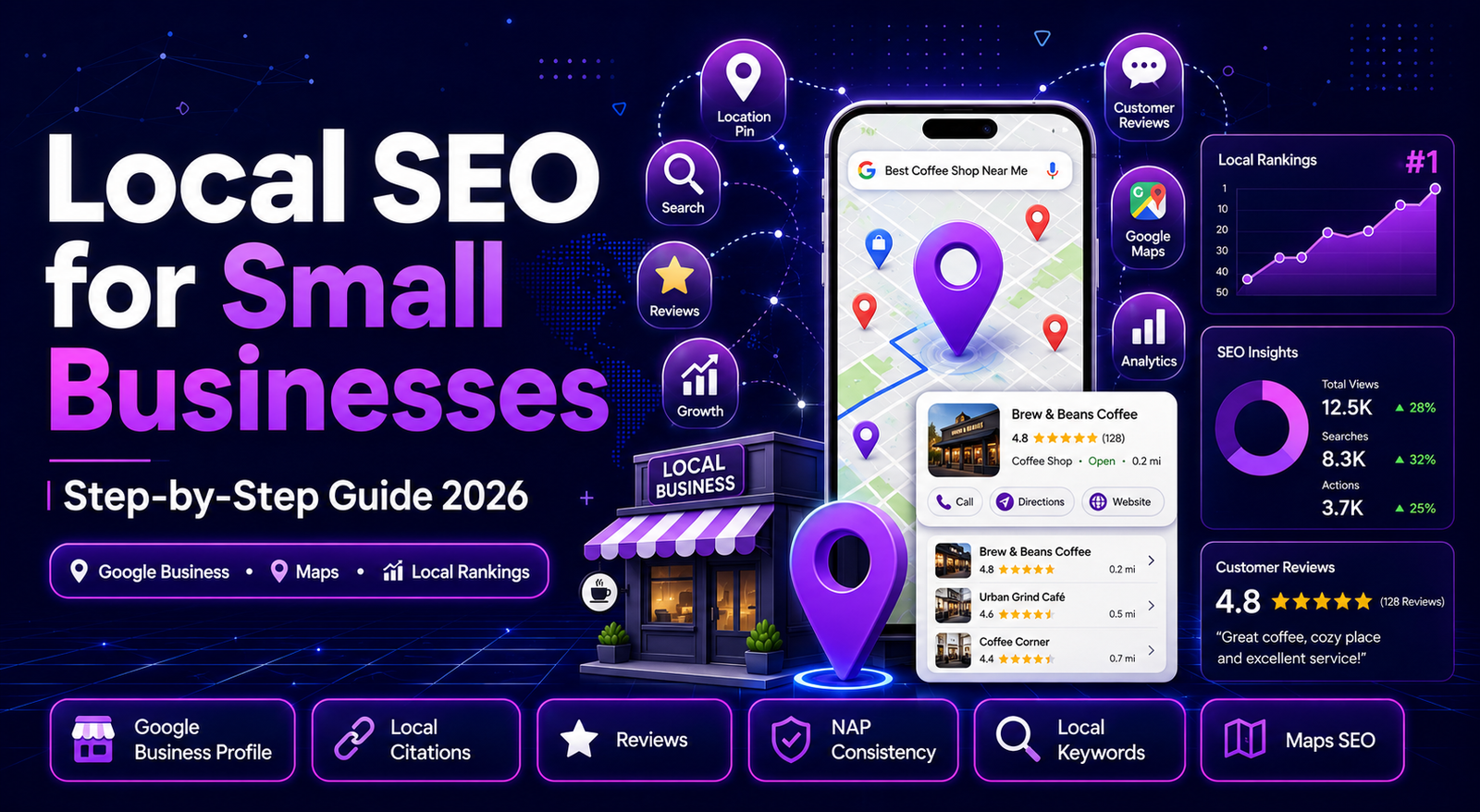
Local SEO is the process of optimizing your business’s online presence so it shows up when nearby customers search for what you offer — think “electrician near me” or “best bakery in Sector 22, Chandigarh.” For small businesses in India, this isn’t optional anymore. Most people now check Google before they ever walk into a shop, and if your business isn’t visible in that moment, a competitor’s will be.
The businesses winning local search today aren’t necessarily the biggest. They’re the ones that show up consistently, accurately, and with proof — reviews, photos, updated information — that they’re active and trustworthy.
Did You Know? Searches with “near me” or “close by” have grown dramatically over the past few years, and a large share of these searchers visit a business within 24 hours of searching.
Your Google Business Profile (GBP) is the single most important local SEO asset you have. It’s what shows up in the Map Pack — that block of three business listings with a map that appears above regular search results.
To optimize it properly:
Pro Tip: Add your service areas explicitly if you serve multiple neighborhoods or cities, even if your storefront is in just one location.
NAP stands for Name, Address, Phone number. Search engines cross-check this information across the web to verify your business is legitimate and where it says it is. Even small inconsistencies — “Rd” vs “Road,” an old phone number still listed somewhere — can quietly erode trust signals.
A citation is any online mention of your business name, address, and phone number — whether or not it links back to your site. Local citations help search engines validate that your business is real, active, and located where you claim.
Priority directories for Indian businesses include Justdial, Sulekha, IndiaMART (for B2B), Yellow Pages India, and industry-specific directories relevant to your niche. Consistency matters more than volume here — ten accurate listings outperform fifty sloppy ones.
Reviews influence both rankings and conversions. A steady flow of recent, genuine reviews signals to Google that your business is active and trusted by real customers – and signals the same thing to prospective customers reading them.
Common Mistake: Many small business owners only respond to negative reviews defensively and ignore positive ones entirely. Responding to both shows an actively managed, trustworthy business.
Generic website content rarely ranks for local intent. Location-specific pages and blog content — like guides, local case studies, or neighborhood-focused service pages — give search engines and customers a clearer signal that you serve a specific area.
If you operate in multiple cities or neighborhoods, dedicated pages for each location (not just a single “Areas We Serve” list) tend to perform far better in local search results.
Links from other locally relevant websites — a local news site, a chamber of commerce, a community blog, a supplier or partner business — carry strong local trust signals. These are often easier to earn than generic national backlinks because the relationships are closer to home.
Sponsoring a local event, partnering with a nearby complementary business for cross-promotion, or getting featured in a local business roundup are all realistic starting points for small businesses without a big marketing budget.
Expert Insight: In our work helping small and mid-sized Indian businesses grow their local visibility, we’ve consistently seen that businesses which combine a well-optimized Google Business Profile with even 5–10 genuine local backlinks outperform competitors who only focus on their website. Local SEO rewards presence across the web, not just on your own domain.